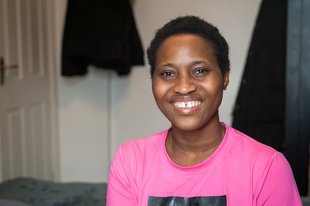
After years of uncertainty, missed warning signs and facing cancer largely on her own, Omolara found something she hadn’t expected from hospice care: support, dignity and people who treat her as a person, not just a patient.
Omolara is a 32-year-old domiciliary care worker, from Belvedere. Before moving to the UK, Omolara was a vibrant professional living and working in Nigeria.
In 2021, she first noticed a lump in her breast. The tumour was removed and she received her written results from a diagnostic centre – the results showed it was High-grade DCIS (stage 0 breast cancer), but she was left without a clear explanation about what that meant and what she should do. She tried to follow things up with doctors and specialists, but she couldn’t get to speak to anyone.
Searching for answers
Without the information she needed to understand what was going on, or what she should do, alone, Omolara decided to do her own research to try to find answers for herself.
“Every piece of information I had about cancer I had to research on my own. I had to search for everything by myself. I had to read up research, sign up for newsletters and join up with groups in America because they were never giving me any information.”
Omolara“Every piece of information I had about cancer I had to research on my own."
The following year, Omolara noticed a second lump and around the same time started to experience back pain - it was noticeable, constant, but bearable.
She again sought medical advice. She told them about the results the previous year and she was advised to have a mastectomy because the first tumour had been cancerous. “I wasn’t in a good place to carry out such decisions because I was – for lack of a better word – severely depressed. It wasn’t something I could do, especially with not knowing for sure whether the second lump was also cancerous. It’s not like they had done a biopsy or anything. They didn’t even know what the lump was and she wanted me to have a mastectomy. In Nigeria they don’t really offer breast reconstruction so it would just be like me having one breast and that’s it.” Some tests were carried out but again, the results were not explained.
Omolara didn’t go ahead with the mastectomy. When the lump was removed, it was benign.
Missing the signs
In 2023, Omolara moved to the UK. A new country, a new job as a care worker, a fresh start.
But soon after, the back pain got worse. “The back pain never went away. I realised it was becoming more severe, but I thought it was because of the stress of moving to a new country and the physical job. I also noticed that where the tumour had been removed, I could still feel a lump but was just telling myself that it was just scar tissue and would dissolve.”
Even at its most severe, Omolara found ways to push through the pain and to keep going. Painkillers didn’t help, so she’d stand in a hot shower or massage instead.
“The back pain was causing terrible pain, and sleepless nights. It was unbearable but I had excuses for it. I didn’t think it was cancer.”
The pain remained and the lump was still there too.
Eventually, she booked an appointment with her GP for a breast exam. The GP said it was a tumour – and quite big. Almost as an aside, Omolara casually mentioned the back pain. “Oh, I also have a back pain. I don’t know, what do you think?” Because of the previous DCIS diagnosis in 2021, and the physical nature of her job as a carer, further tests were requested. The referral to the Queen Elizabeth Hospital (QE) came quickly and in quick succession she had a mammogram, biopsy and a series of scans.
The diagnosis
When the results came back, Omolara was told she had cancer.
“I listened. I was staring at the doctor trying to process the news. I didn’t know what questions to ask because I wasn’t expecting that. The doctor was empathetic and asked if I needed time to process the news.
“The only thing I knew about cancer was the staging, so that’s the only question I asked her ‘what stage is it’? She said grade three or something, and I said ok out of how many grades and she said that’s the last grade. So I asked ‘ok what comes next what happens now, what are we doing?’”
Facing cancer alone
While she waited to be seen by the QE, Omolara was referred to Guy’s Hospital. She spoke about the isolating feeling of looking around and being the youngest person there. As well as that, she said: “I felt like people were looking to see who I came with and then when they saw my name come up, they would realise ‘oh she is by herself and she is the one being seen.”
It was an emotional and confusing time for Omolara, and sometimes hard to understand everything that she was being told. She dealt with it all on her own.
“All of the appointments I went to by myself. Most times when I get there, I’m not taking in what I’m being told, it sounds like an echo. I’m just staring at them, and they have so much information – so many things they are saying that most of the time it sounds like gibberish to me.”
After one appointment, her doctor hugged her and cried. Omolara chuckled as she remembers:
“She hugged me and then she started crying and then I started crying. I think it then dawned on me ‘oh if my doctor is crying then it’s really bad’.”
Treatment began in November 2023, and one of the first decisions she faced was about her fertility.
“I was given an injection to medically induce menopause. I was sad about that.”
It wasn’t just the treatment itself – it was the loss of choice. “I had been 50:50 about whether I wanted children or not… but one thing about me is I love being in control and choosing what I want. If I didn’t have cancer, chances are I still wouldn’t want to have children but it’s just that it’s taken away from me. There is no ‘maybe’ anymore. It’s ‘no’. I was told that if I wanted to wait, they would have to defer treatment. So I said don’t worry about it, let’s just start.”
Finding the support that was right for her
Omolara was referred to the Community Hospice in December 2025 for pain management, and the progression of her condition, where they felt that she would benefit more from local hospice care.
“At first, it felt that they were discharging me to die. Most people, once they hear ‘hospice care’ or ‘palliative care’, the first thought that comes to mind is end of life kind of situation.”
But that isn’t what she found.
From her first visit, something felt different to the care she’d received before. She was finally able to get the support she needed. “The first person I met with was Sally. We talked about my condition, she gave me some leaflets and asked me some questions. She said that even though they have people come in to die, it isn’t like a traditional hospital setting, or a home, it’s a place to make people comfortable. She made me feel differently about the hospice. It was nice and she showed other things you can do while you’re here.” She went on:
“But even though they try to make it like ‘oh you’re not coming here to die’ kind of situation, they still have to have the tough conversations, the reality of the dying aspects too.”
What made it different wasn’t just about treatment - it was about being able to reach out to someone, to ask questions, to feel heard.
“The fact that if I am feeling any type of way, I can just call and ask ‘what do you think, what should I do?’”
It felt personal, which meant that she no longer felt like she was dealing with her condition on her own. Now there was someone to turn to for help when she needed it.
Omolara"If I am feeling any type of way, I can just call and ask ‘what do you think, what should I do?’”
When she needed urgent help for a slipped disc, her first call was to the hospice nursing team where a nurse advised her to call 999 and talked her through how to explain the symptoms so they could be taken seriously. The nurse stayed alongside her, calling her back a short time later to make sure she received the attention she needed. She was taken to the QE, “Even when I was in QE, the hospice palliative care team knew that I was there and came to see me a few times before I was discharged and also adjusted my medication before I left.
“The way I am being treated under the hospice makes it feel like there are not a lot of other patients. They remember I exist.” Omolara also started receiving support from the palliative care social work team. She said:
“It feels more like they are volunteers. Like they’re not being asked to do anything but they’re doing it because they want to, and like more than ‘I’m here to work’.”
“The hospice is about support, guidance and being treated as a person, not just a patient. And having someone there who knows your name, your story, and what matters to you.”
This is the difference that compassionate care can make when you see the person and not the condition.
There is more to the hospice than just dying
For Omolara, changing how people see hospice care matters to her.
“I want people to see that there is more to the hospice than just dying. When people see that there is more than just where they die, it gives them hope.
Looking back, Omolara is honest about her experience. “Early detection of cancer is supposed to save lives. The main problem is that I wasn’t taking my back pain seriously and now it has made it uncurable.”
She doesn’t say that to blame anyone but hopes that it is a reflection others might hear.
She is grateful for the support that she received from the healthcare professionals who have supported her by making the necessary referrals along the way: “I can’t imagine if I had to advocate for myself because I wasn’t taking it seriously. I have seen a lot of videos some people that have late diagnosis and by the time they have had to advocate for themselves and fight about al lot of things they’re not supposed to be fighting about, it has now become too late for them.”
Omolara is still navigating what comes next. And with the right care and support available to her, she no longer has the burden of facing it alone.
Mum’s story
There is more to Omolara’s story. While undergoing treatment, Omolara would update her mum in Nigeria. During one of their catch ups, her mum revealed that she had found a lump in her breast.
“Even from the first day, I didn’t think of cancer – I wasn’t worried… I never thought ‘lump equals cancer’.” Even so, she encouraged her mum to get a biopsy. The biopsy came back benign. But afterwards, things changed.
Omolara and her mum followed very different paths for treatment. While Omolara looked for medical answers and guidance, she found out that her mum had discontinued her medical care and was drawn toward people offering spiritual healing.
“Someone started telling her it was some witches and wizards that was the reason for what was happening to her… and these strangers were exploiting her, claiming to be treating her and telling her all sorts of things.”
Her mum’s condition worsened and her behaviour became more secretive.
“There was a time that we had to start looking for her, because she started travelling far away to see people and not telling anyone.”
Omolara’s mum died of cancer in June 2024, four days before her 55th birthday.
“This really upsets me because it makes me feel like she could have still died if she went the medical route, but the other route she went through made her die like a rat in the sewer.”
“My mum is the single strongest person I know in my entire life - but she died like she never worked a day in her life.”
Omolara wants her mum’s story shared “There are still people in Nigeria that believe that breast cancer means that someone has ‘charmed you’ and that you can get help to wash it away.” One of the reasons I want my mum’s story to be told is because ignorance can do a lot of damage. If she went the medical route and then got treatment at home, maybe she would still be alive, maybe she would be dead. We don’t know, but it was painful to see the way that she changed; her personality, how she thought. She became secretive. We were close and would talk about everything. But now she would just disappear, for days and not take calls. Until the day she died she was still adamant she was going to live.”
What happened to her mum still shapes Omolara’s grief today. “I want people to know that it’s ok to believe in spiritual guidance, but just do the medical route. Follow the research and results and however you want to pray – it’s whatever works for you, but not at the expense of the medical part of it.”